Policy Is Not Politics
Policy Is Not Politics: Why Ethical, Person‑Centred Practice Is Being Mislabelled as ‘Political’
If you have followed me for any amount of time, you will know I talk a great deal about policy, systems and structures. My social media posts and content which describe definitions and obligations as set out in The Equality Act and related legislation. Speaking about the lived experiences of inequalities and the legal frameworks which outline how we can maintain and protect human rights has been challenging. Increasingly, I am told that this work is “too political”.
It isn’t.
This confusion sits at the heart of many of the challenges we now face in ethics, equity, human rights and sustainability. So, it is worth being very clear about the difference.
Policy and Politics: Shared Roots, Very Different Functions
The words policy and politics share a common linguistic origin, which is one reason they are so frequently confused but their meanings diverged centuries ago and for good reason.
Both terms trace back to the ancient Greek polis, meaning city or community. In classical thinking, the polis was not simply a place of power, but a shared civic space where people lived, governed and made collective decisions. From this root, two distinct concepts emerged.
Politics developed to describe the struggle over power within the polis:
who governs, whose interests dominate and how authority is gained, maintained or contested.
Over time, politics became associated with ideology, identity, loyalty, competition and control.
It is inherently relational and often adversarial, centred on “us and them” dynamics, persuasion and the negotiation of power.
Policy, by contrast, evolved to describe the mechanisms of governance:
the rules, procedures and systems through which decisions are implemented once authority exists. Policy is concerned with how things work in practice, how services are delivered, how laws are applied, how resources are allocated and how people experience systems in their everyday lives.
In modern governance terms:
Politics decides direction
Policy determines delivery
They intersect, but they are not the same.
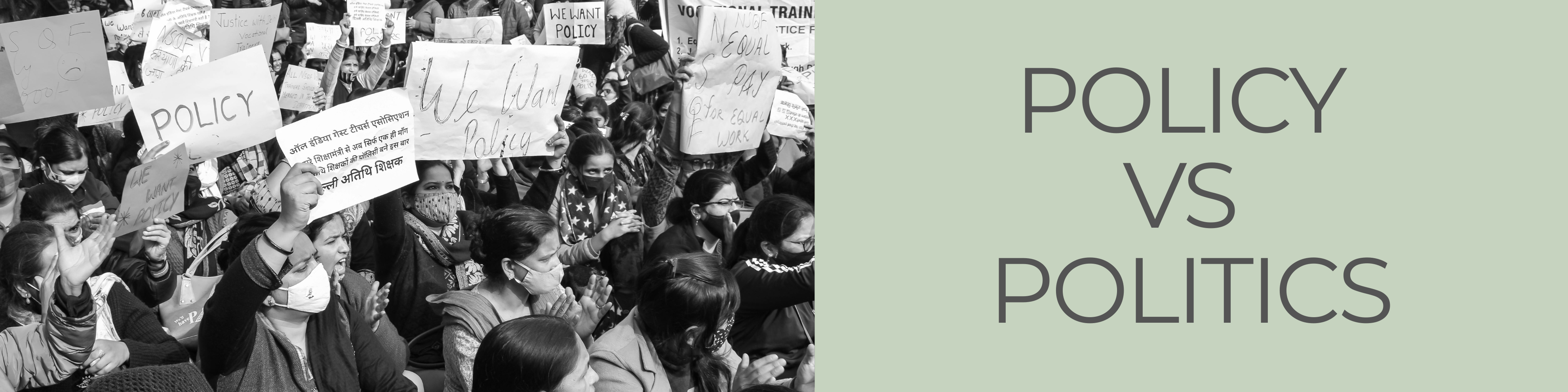
Why People Struggle to Distinguish Between Them
There are three main reasons the distinction has become blurred.
First, policy is created within political environments, so people often assume it carries the same ideological intent as political debate. In reality, once legislation exists, policy becomes an operational obligation, not a political opinion.
Second, rights‑based and ethical frameworks are increasingly framed through political narratives. When human rights, environmental protections or equity are discussed publicly through polarized language, they become associated with political identity rather than legal duty or professional practice.
Third, systems thinking is poorly taught. Many people are never supported to understand how governance structures function below the surface, how legislation translates into guidance, regulation, commissioning, inspection and lived experience. Without that literacy, it becomes easier to dismiss structural critique as “political” rather than recognizing it as systems analysis.
Why This Confusion Is Harmful
When policy is mistaken for politics:
Legal and ethical obligations are treated as optional beliefs
Evidence‑based critique is dismissed as ideology
Person‑centred practice is reframed as activism
Professionals are discouraged from naming harm or risk
Systems remain unchallenged, even when they fail people
This is particularly damaging in areas such as human rights, equity and sustainability, where the purpose of policy is preventative, to reduce harm before it occurs, not to win debates after the fact.
We can see this playing out in the media narratives related to racism, religious discrimination and hierarchies of inequalities, presenting information in confusing and inaccurate ways which increase division. Creating environments where the lived experiences of some are ignored while other demographic groups are prioritized, not based on need but based on political rhetoric. Generally, this leads to widespread misunderstanding of the actual situation, applicable legislation and consequential dangers being faced by vulnerable groups.
The DRose Position
At DRose, we are explicit:
Understanding policy is a professional responsibility, not a political stance.
Our work focuses on:
How systems are designed and implemented
How ethics are operationalised
How equity is embedded in planning and delivery
How people experience governance in real life
This is not politics.
It is infrastructure for ethical practice.
And if that makes people uncomfortable, it is not because the work is political;
it is because systems do not like being examined closely.
Understanding Policy: How Systems and Structures Actually Work
Policy is about how decisions are implemented, not who is in power.
It is the practical architecture that governs:
How services are designed and delivered
How organisations meet their legal duties
How rights are protected in everyday practice
How people experience systems when nobody is watching
In the UK, policy‑driven practice is not optional or ideological. It is embedded in law and regulation, including:
The Human Rights Act 1998, which requires public bodies to act compatibly with fundamental rights
The Equality Act 2010, which places legal duties around non‑discrimination and reasonable adjustments
The Health and Social Care Act 2008 (Regulated Activities) Regulations 2014, which explicitly mandate person‑centred care, dignity, transparency and good governance
Policy literacy means understanding:
How legislation translates into operational decisions
How systems create or reduce harm
How governance frameworks protect people, not organisations
This is the foundation of ethical leadership.
Politics: Division, Identity and Control Mechanisms
Politics, in contrast, is about power, identity and control.
It often relies on:
“Us and them” narratives
Simplification of complex social issues
Emotional polarization rather than evidence
Short‑term positioning rather than long‑term outcomes
When ethics, equity or sustainability are framed as “political opinions”, they become vulnerable to dismissal, backlash and erosion not because they lack merit, but because they are incorrectly positioned as ideological rather than structural and legal necessities.
When in a discussion with someone about the policing of bathrooms to ‘protect women from predators’ and I stated that legally he has no right to question anyone about their genitals and standing outside women’s bathrooms asking such questions, seemed like predatory behaviour. Statistics show that women are more in danger from their partners or ex-partners and focusing our energy on addressing domestic abuse would be a more effective use of time.
The response I got was “well legally and statistically, I don’t care”.
No facts, no evidence, no fact-checking or lived experience would shift this individuals mindset.
This is where real damage begins.
The Cost of Politicising Human Rights and Sustainability
There is clear evidence that politicising rights‑based and environmental frameworks undermines their effectiveness.
Human rights in the UK are deliberately embedded into policy mechanisms, not party agendas. The Human Rights Act was designed to create institutional dialogue between Parliament, courts and public bodies ensuring rights are considered before harm occurs, not after.
Similarly:
Person‑centred approaches in healthcare and public services are proven to reduce inequalities, improve outcomes and strengthen trust when implemented system‑wide, not treated as optional values
Regulatory bodies such as the Care Quality Commission explicitly assess dignity, inclusion, consent and governance as measurable standards, not ideological preferences
When these frameworks are politicised:
Evidence‑based practice is dismissed as opinion
Legal duties are reframed as optional beliefs
Professionals are discouraged from speaking about harm, risk and inequity
Preventative systems fail, increasing long‑term social and economic costs
This is not neutral. It is actively harmful.
Why Social Impact is Labelled “Too Political”
After spending more than 2 decades working in the intersections of education, health, social care and charity work, prioitising equality and inclusion practices, I have never experienced so much pushback as I am seeing right now. Being told that, I’m “too political” when discussing:
Describing the impact of discrimination
Social Impact
Lived Experience
Explaining legal frameworks
Human rights obligations
Equity‑based planning
Environmental responsibility
Ethical governance
Person‑centred systems
Yet my work is grounded in:
Current UK legislation
International human rights conventions
Established ethics frameworks
Regulatory standards
Person‑centred, evidence‑based and trauma-informed practice
I am not advocating ideology.
I am describing how systems function and how harm is created or prevented.
Calling this “political” is not a critique of my work; it is a misunderstanding of what ethical governance actually requires.

The DRose Position: Ethics as Infrastructure
At DRose, we are clear:
Ethics are not opinions
Equity is not a trend
Human rights are not political bargaining tools
Sustainability is not a lifestyle preference
They are infrastructure.
They sit underneath:
Ethical decision‑making
Engaging diverse stakeholders
Equipping people to do their jobs well
Representative leadership
Equity‑based planning
Transparent accountability
Sustainable ecosystems
This is why our work focuses on policy literacy, systems thinking and person‑centred governance, not political alignment.
Moving Forward
If we want resilient organisations, healthy communities and sustainable futures, we must stop confusing policy with politics.
We need:
Less polarisation
More structural understanding
Clearer accountability
Courage to name harm without being silenced
Ethical, equitable practice is not “too political”.It is the minimum standard and we can implement it most effectively when we work collaboratively, with shared values. That is why DRose Ethics in Action has been established to support our community of professionals who strive to deliver ethical and equity-based services but are feeling isolated and exhausted.
Register your interest in our new professional community here >>> Ethics in Action.